TLDR: Here’s how long each part of the day really takes
If you want to create a wedding day timeline for a wedding day in Napa that feels smooth and relaxed, work backwards from your ceremony start time. As a general rule:
- With a first look: plan your ceremony for 2.5 hours before sunset
- Without a first look: plan your ceremony for 3 hours before sunset
And here’s how much time each part of the day realistically needs:
- Details + final touch ups: 45–60 minutes
- Bride getting into dress: 10–15 minutes
- Bridal portraits: 30 minutes
- Groom getting ready: 20–30 minutes
- First look + portraits (optional): 30 minutes
- Wedding party portraits: 30 minutes
- Ceremony: 30–60 minutes
- Family formals: 30 minutes
- Just married / sunset portraits: 30 minutes
- Dinner & reception: make sure your photo/video team eats when your wedding party eats to avoid missing speeches or key events
If you want the deeper breakdown (plus three sample timelines, Napa lighting notes, and how to build your own schedule) keep reading.
The Philosophy Behind a Well-Crafted Timeline So You Can Create Your Own
A wedding day timeline isn’t about controlling every minute. It’s about creating a flow that protects your priorities and gives you space to actually enjoy your day.
Here’s what I tell every couple:
Your planner builds the overall structure of the day, but your photographer guides the parts of the timeline that directly impact portraits, lighting, and pacing.
A strong timeline is built around:
- Lighting — especially in Napa where the sun dips behind the hills early
- Your priorities — more portraits? More time with guests? A break built in?
- Realistic time blocks — no 5-minute transitions that magically require teleportation
- Intentional buffer time — early in the day and around major transitions
- Breathing room — because no one wants to sprint into their ceremony
When these pieces work together, the whole day feels easier, calmer, and more intentional.
How Long Each Part of the Day Actually Takes (and Why)
Details & Final Touch Ups
45–60 minutes
This part of the day does double duty. While hair and makeup finish final touch ups, your photographer is styling and photographing your invitations, rings, accessories, bouquets, perfume, shoes, and any meaningful heirlooms.
The time needed varies based on how many items you have, how complex your invitation suite is, and whether florals have arrived. This window also keeps you from feeling rushed in those final moments of prep and ensures your photographer has time to capture everything while hair and makeup is still fresh.
Bride Getting Into the Dress
10-20 minutes
Getting into a wedding dress almost always takes more time than couples expect. There are bathroom breaks, undergarments, last minute steaming, sticky tape adjustments, strap fixes, button loops, de-bustling layers, and the reality that this is a big emotional moment.
Padding this part of the day ensures you are not flustered before the getting ready portraits start or feel like you’re running behind before the day really gets started.
Pro-Tip: Schedule your hair and makeup to be completed so that you are not the last to get out of the chair. If things run behind, we can always start without a bridesmaid or parent, but we cannot start the day without you.
Bridal Portraits & Getting Ready
30-45 minutes
Once the dress is on and everyone takes a breath, we move into soft, natural portraits. This time usually includes putting on your jewelry, a few images with mom or bridesmaids, and a few solo portraits of just you and your bouquet.
Often times, this part of the day is when brides share first looks with their wedding party or parents. So, this is where you’d want to build in time for this moment to unfold.
Groom Getting Ready
The guys always have it easier and faster than the girls, but it still takes more time than you’d think. Tying ties, pinning boutonnieres, fastening cufflinks, wrangling the groomsmen, and gathering everything in one place often adds unexpected minutes to the morning.
One of the best things you can do is practice ahead of time. Do not wait until the morning of the wedding to learn how to tie a bowtie or decide how you want your pocket squares folded. A little preparation makes this part of the day smoother, less stressful, and far more enjoyable.
First Look + Portraits (Optional)
30 minutes
If you decide to do a first look, I recommend scheduling 30 minutes. This gives you time to genuinely enjoy the moment, hug and talk to one another, share private vows or a gift if you’d like, and ease into portraits when you’re ready.
For winter weddings, I strongly encourage couples to consider adding a first look.The sun disappears behind the hills earlier in Napa, and this pre-ceremony portrait window removes the pressure of trying to fit everything into a short amount of time after the ceremony. The majority of the time, there isn’t a second window of opportunity for us to sneak off during sunset for portraits. So, if portraits are important to you, this is the one time a first look can make a meaningful difference.
Wedding Party Portraits
30 minutes
This is a mix of group photos, individual pairings, and relaxed, personality-filled images. Having some time scheduled for each side to be captured before the ceremony keeps cocktail hour open later for family and couple portraits, and a few of the entire group together. If you are sharing a first look, all of these can be accomplished prior to the ceremony.
For larger wedding parties, this time may increase slightly.
Ceremony
30–60 minutes
Outdoor weddings in Napa typically run about 30 minutes, which includes the processional, readings, vows, rings, and recessional. Religious ceremonies or cultural traditions may take longer.
This is the anchor for the entire timeline, and nearly every part of the day works backward from this moment.
Family Formals
30 minutes
Family formals are one of the most meaningful parts of the day, but they can also become the most stressful if there is not enough preparation. This is the one portion of the timeline where organization truly makes or breaks your experience. When everyone knows where to be and when to be there, this part of the day flows quickly and feels surprisingly easy. When people wander off or do not realize they are needed, it can create delays and unnecessary chaos and tension.
To keep this part of the day smooth, your photographer should ask you for a list of ten to fifteen must have family groupings. This list includes names and relationships so the flow can be organized, grandparents or anyone with mobility needs can be prioritized, and we can move through the groupings efficiently. Some planners request this information, but many do not, so it is important that your photographer leads this piece.
Something I always advise my couples to do is to let everyone know that they are included in the family formals. A simple text ahead of time is all it takes. Without this step, people naturally head to cocktail hour because they do not realize they are needed, which slows everything down.
Once everyone knows where to be, the rest becomes easy. With an organized list and a clear flow, family formals are smooth, efficient, and respectful of everyone’s time. A well-planned thirty minute window is all we need.
Newlywed Portraits
30–40 minutes
When couples know they want more than “just a few” portraits, they often plan for thirty to forty minutes of portrait time. This window is usually divided into two parts. The first happens immediately after the ceremony, when emotions are high. The second often takes place during dinner or just afterward, when guests are settled and you can slip out for a few sunset portraits without anyone noticing you are gone.
For spring and summer weddings, you still have the option of slipping away during dinner or just after for sunset portraits. It is a beautiful pause in the evening and produces some of the most loved images from the entire day.
For winter weddings, this may be the only opportunity for natural-light portraits, so couples often prioritize this right after the ceremony.
Either way, this is often the first chance you two have to breathe and take in the day together.
How Lighting Changes Everything in Napa Valley
Lighting shapes a wedding day more than any other timeline factor.
Here in Napa, the sun drops behind the hills before the official sunset time you see on your weather app. If your ceremony starts too late, you lose the natural light needed for family formals and newlywed portraits.
This matters most for late fall and winter weddings.
- Summer weddings have longer light and more flexibility for portrait windows
- Winter weddings require precision with earlier ceremony times
- Vineyard weddings often lose backlighting early due to trees or hills
- Estate venues may have shaded courtyards that impact portrait timing
If natural-light portraits are important to you, your ceremony time must be built around the sun… not the printed schedule or what works for guests. This is one of the biggest reasons photographer input matters and is exactly why I created a guide for how to figure out the best time for your wedding ceremony.
Sample Wedding Day Timelines
(These are templates — your timeline will always be customized to your location, season, and priorities.)
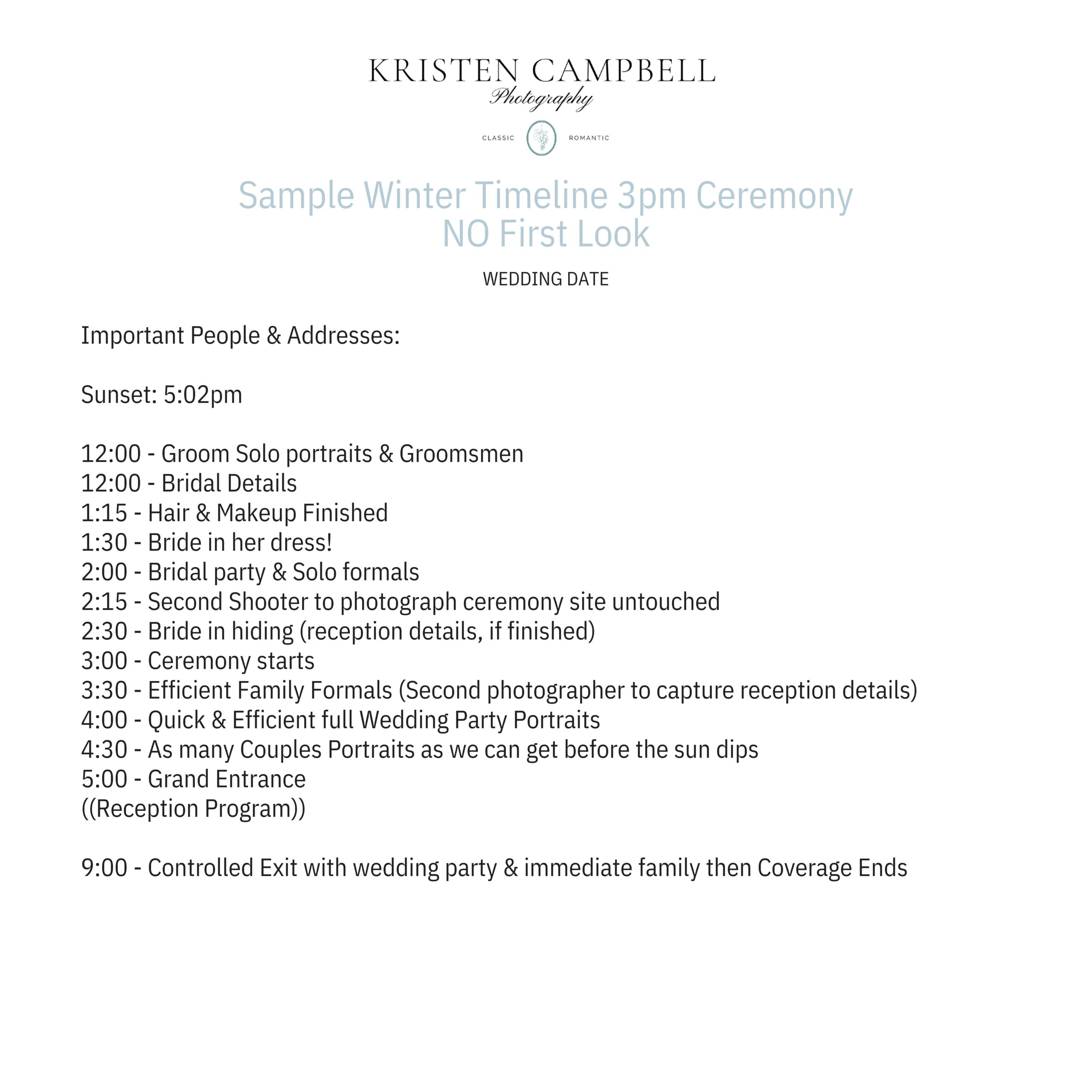
1. Winter Wedding Timeline • No First Look • All at One Location (3:00 PM Ceremony)

Why this works
- Winter light fades quickly, so the ceremony must be early.
- All portraits happen immediately after the ceremony to capture as much natural light as possible.
- Getting ready on-site avoids travel delays and gives couples more breathing room.
What could go wrong + how to prevent it
• Hair & makeup runs late → Start hair & makeup 30 minutes earlier than planned.
Winter timelines have no extra buffer, so starting early protects everything that follows.
• Family formals take longer → Use a clearly organized list starting with large groups.
When people know ahead of time that they’re in photos, this part of the day is smooth and efficient.
• Not enough daylight for portraits → Prioritize couple + wedding party portraits first, then switch to flash for family formals.
This is a reliable backup plan that works beautifully in winter. If light disappears, we capture your must-have portraits first and finish family photos indoors or with flash. Everything gets documented without stress.
• Rain → Choose an indoor or covered portrait location as a backup.
Winter weather is unpredictable, so having a sheltered option ready prevents last-minute scrambling.
2. Summer Wedding Timeline • No First Look • Travel Between Locations (5:00 PM Ceremony)

Why this works
- Longer daylight means more flexibility.
- Getting ready off-site works well as long as travel time is padded.
- Newlywed portraits can happen post-ceremony with plenty of light.
What could go wrong + how to prevent it
- Traffic between venues → Add a 15–20 minute buffer to all travel windows.
- Guests arrive early → Keep couples hidden in a separate room to avoid rushed portraits.
- High heat → Plan shaded portrait locations during midday hours.
3. Summer Wedding Timeline • First Look • All at One Location (5:00 PM Ceremony)

Why this works
- The first look allows wedding party and couple portraits before the ceremony.
- Cocktail hour stays free for enjoying guests or spreading out remaining photos.
- Sunset portraits later give couples a second portrait window with beautiful light.
What could go wrong + how to prevent it
- Family formal delays → Communicate arrival times clearly and designate a point person.
- Heat during first look → Choose a shaded or indoor reveal spot.
- Ceremony starts late → Use a planner or coordinator to keep pre-ceremony transitions tight.
Final Thoughts
The strongest timelines are built with intention and realistic pacing. When you understand how long things actually take and give yourself the breathing room you need, your wedding day feels smoother, calmer, and far more enjoyable. A well-structured flow does not limit your experience. It supports it.